Editorial Note
Historically Russian imperialism has its roots in brute force oppression, poor economic development, domestic poverty and grandiose aspirations for becoming a global power.
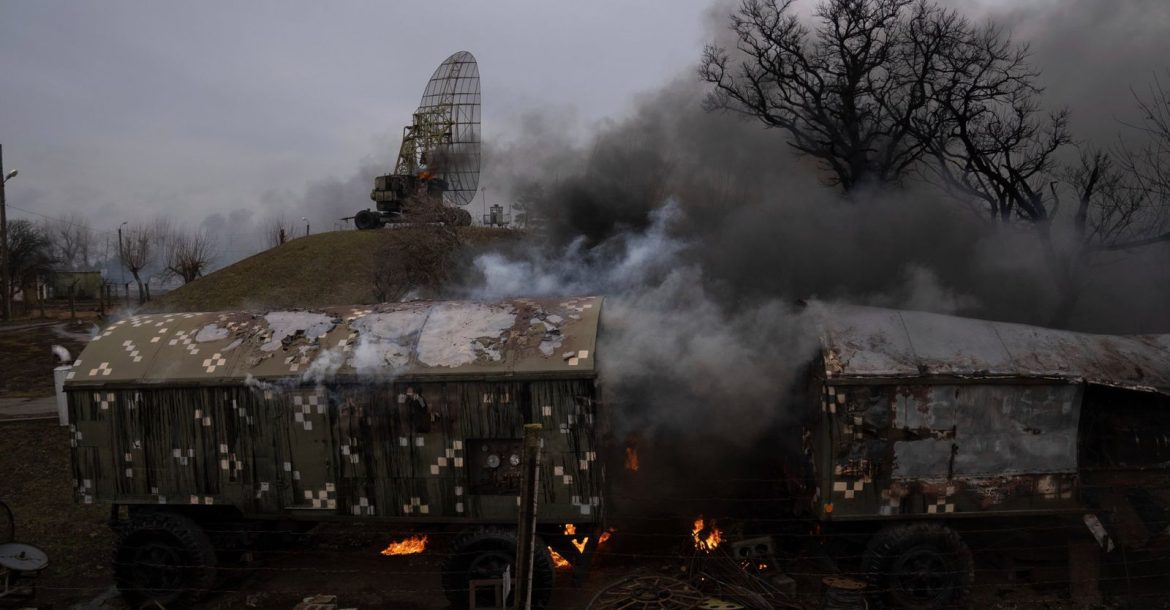
The Russian President, Vladimir Putin’s war on Ukraine euphemistically termed “special military operation” has opened Pandora’s box amidst new global geopolitical alignments and probable revisionist coalitions, which could threaten global peace and security. Ever since the Balkan wars in the 1990s, limited to a disintegrating Yugoslavia disrupted the much-coveted peaceful coexistence in the European federation, the current onslaught of Russian forces across major cities in Ukraine brings back painful memories of aerial bombardments and rolling tank divisions with one major exception. Now, the nuclear superpower has started the war and given the human penchant for self-destruction, the world is teetering on the brink of an apocalyptical event that could potentially obliterate the human species if restraint is abandoned by global powers.
The age-old adage, “the first casualty in war is truth”, attributed to ancient Greek dramatist Aeschylus, sometime in 550 B.C., still rings true in the 21st century when NATO, the US and its allies and Kremlin engage in reciprocal condemnation as the likely malefactors of the current quagmire in Ukraine. Vladimir Putin claims that Ukraine has no right to exist and isn’t a real nation. An assiduous examination of history reveals the deep socio-cultural and economic ties that bind Russia and Ukraine. Russian history started in the Kievan-Rus region in Ukraine and its official religion spread from there. Kyiv was a teeming metropolis when Moscow was just a mofussil town. Some of the momentous battles for Russian liberation, especially the Battle of Poltava in 1709 was fought on the playgrounds of Ukraine. The Black Sea Fleet, guarding the Russian territorial interests in the Mediterranean is based out of Sevastopol in Crimea, still internationally recognized as part of Ukraine, despite the Russian annexation of the Crimean Peninsula in 2014.
Political and military strategists, global intelligentsia and think tanks consider NATO’s eastward expansion into satellite nations of erstwhile USSR and federal republics of Russia and culminating in the likelihood of Ukraine joining NATO have enraged the Russian President to pursue the current military engagement in Ukraine. NATO’s legitimacy as a politico-military entity probably ceased with the disintegration of the Soviet Union in 1989 and ending the decades-long Cold War with the US emerging as the ‘global policeman’ in an increasingly unipolar world. Many consider that NATO should have been disbanded or at least honoured the ‘gentlemen promises’ made to the Russian President Michael Gorbachev by then mediators US Secretary of State, James Baker, along with West German foreign minister Hans-Dietrich Genscher that NATO will not “expand an inch to the east” once the German unification had consummated.
But the war industry is a highly lucrative business. The lurid temptation of the colour of money is too irresistible to overcome and often yielding to it is the best solution. The optimism of diplomats and political leaders post-Cold War, hoping to usher in sustained global peace and order waned when European Union and NATO immediately set to recruit nations comprising the erstwhile Communist Blocs into their fold. Multinational corporations that profited from the Cold War proliferation of arms and ammunitions were delighted in sustaining their profitability when Poland, Hungary, the Czech Republic, Bulgaria, Estonia, Latvia, Croatia, Albania, Lithuania, Romania, Slovenia, Slovakia, North Macedonia and Montenegro joined NATO and were provided hefty financial loans to modernize and reconfigure their military hardware congruent to stringent standards of NATO. To the utter dismay and aghast of the Russian administration, military bases and deployment of arms across the vast Russian borders by NATO forces met with little or no international outcry as breaches of post-Cold War assurances.
A NATO missile base in Poland just 100 kilometres from the Russian border, though it made little geopolitical sense, garners immense commercial sense. Russia once again is crowned as the inexorable enemy by the powers that be who prolonged futile engagements in Afghanistan and destroyed Iraq, engendering the rise of barbaric ISIS and irretrievably pushing the country into civil war, bloodshed and anarchy. After a million deaths and many more displaced, where innocents were butchered and as American poet A.H. Auden wrote, “little children die in the streets” and no weapons of mass destruction (WMD) were ever found by international ombudsmen that triggered the US and UK joint military intervention in Iraq, the carnage was underplayed by a simple, dismissive and innocuous phrase “lapse in intelligence”. If there is no enemy, create one!
Ukraine has a complex history and its polyglot population is divided over its strategic decision to join NATO. The western part is predominantly Catholic and speaks Ukrainian whereas the east is composed of faithful of the Russian Orthodox Church and speaks Russian. In Crimea, 60% of the population are Russian and the pan ethnic-Russian speaking population owe allegiance to the Russian Federation and detest a Ukrainian membership of NATO. It has been alleged that Russian armed forces are supporting and patronizing a fully armed Russian separatist movement in the Donbas region of Ukraine since 2014 to destabilize Ukrainian Independence.
Vladimir Putin’s tirade on the eve of the invasion is nothing short of paranoia. Though Ukraine is a member of the United Nations, the Organization for Security and Cooperation in Europe and the Council of Europe, Putin’s preposterous declarations that Ukraine has no right to exist as a sovereign state, defies logic and makes his grip on reality dubitable. While NATO, led by the US contends that Ukraine joining NATO comes under the purview of sovereign decision making, an alternative scenario of missiles stationed across Canadian and Mexican borders with the US is an unsavoury proposition that will conjure up every tactic and arsenal in the US state department to fight against!
Historically Russian imperialism has its roots in brute force oppression, poor economic development, domestic poverty and grandiose aspirations for becoming a global power. It would therefore become an automatic choice for Ukraine to liberate itself from the sphere of influence of the Kremlin and pave a new path of modernization in line with developed nations of Europe and the US. Modernization has always been the bane of the USSR and Russia as the staggering revenues from crude oil and natural gas reserves were mainly deployed in the proliferation of arms and ammunition at the expense of social welfare programs and infrastructure projects. Russia should have taken a leaf from the Chinese playbook on steering an impoverished nation in the 1970s into an economic powerhouse of the 21st century.
Ukraine, under the leadership of Volodymyr Zelenskyy, is pro-west in its socio-economic outlook. He is committed to steering the nation into a path of rapid economic development and modernization from the corruption-plagued and war-torn country he had inherited. His government’s overtures with NATO and the European Union are based on dual-pronged issues of national security (from the precedence of the Russian invasion of Crimea and Georgia) and economic advancement, thereby raising the income and quality of life of the masses.
The Euromaidan Revolution in 2014, ousting the reactionary Ukrainian President, Viktor Yanukovych and overthrowing the government for refusing to sign a political association and free trade agreement with the European Union bears ample testimony to the mandate of masses preference of economic reform over pseudo-nationalism and ethnonationalism. If Zelenskyy succeeds in his economic vision, it will trigger a bandwagon effect in Russia demanding similar socio-economic outcomes from Vladimir Putin. Besides security interests and attendant geopolitical risks of Ukraine joining NATO, this economic angle could also be a probable reason why Putin has invaded Ukraine.